



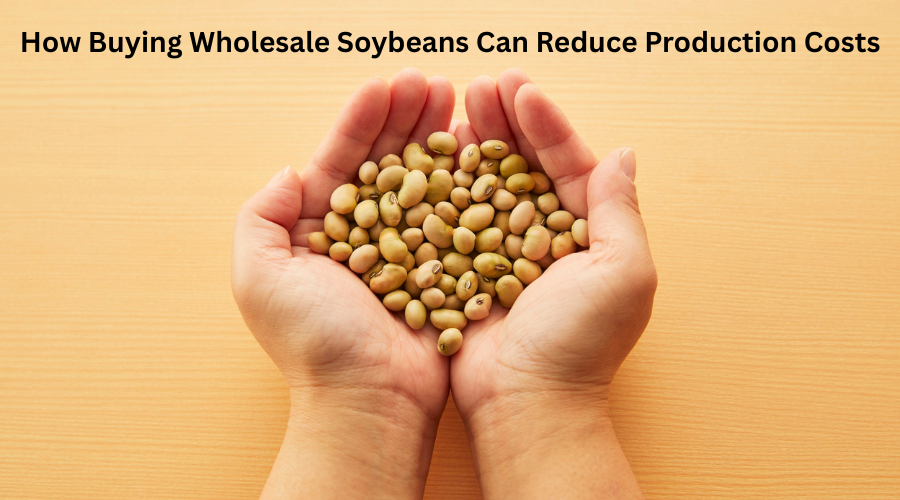
Every business knows the advantages of bulk buying, especially if there is a need for consistent production. No one wants to face downtime or an increase in logistics costs because of a stock shortage. To prevent all these problems that increase the production cost, businesses go for an extra massive procurement size. Then they get the benefits below.
There are some logistics costs that are variable. They are the ones that increase or decrease when the order sizes fluctuate. Sometimes, companies do not have enough stock, which makes them reprocure it. This is why the logistics cost increases, and it affects other factors also.
When companies go for wholesale procurement, especially in massive quantities, they reduce that cost. Then they get large enough stocks to deal with massive demands. On soybean procurement, companies save production costs by going for one-time procurement. They know the consumption size whether they manufacture soymilk, soy sauce, tofu, or anything related to them. Therefore, the production cost also drops because the logistics cost is reduced through a one-time mega procurement.

The per-unit cost has to be the lowest when it comes to bulk procurement. Even in the case of soybeans, there are MOQs in terms of bushels, which decide the per-unit cost. This cost can be really low if the order size is massive. Manufacturers reduce per-unit cost based on the order size. For instance, if the per-unit cost of a bushel is $15, it could be further reduced by a manufacturer if the number of bushels is increased. Therefore, buyers prefer to procure massive numbers of bushels to get a way lower per-unit price than the market.
This is the biggest advantage, which makes companies go for wholesale soybean seed procurement. They are aware of reducing the production cost by reducing the raw material cost. Since soybeans are the main ingredient in soy products, having an extremely low price will surely affect the revenues.
There is no doubt that non-GMO soybeans are better and safer than the GMO ones. This is why the cost of production and price of non-GMO soybeans are also higher. The reason is that the organic methods are involved in their production. There is the lowest risk of side effects in the on-GMO type because of that. Also, the GMO type contains various chemicals that can affect the consumers’ health later. It could lead to various health effects on the soil, consumers, and the environment. The reason why GMO soybeans are more cost-effective is that their production rate is massive. The inorganic methods provide much larger outputs than the organic methods.
The quality has to be consistent when procuring anything in bulk. The same goes for soybeans because lots of factors are connected to it. If the quality is not consistent, the color, taste, and even health benefits will vary throughout the entire production. Soybean products are available in a wide range, and each product has specific requirements. To provide the best results, companies ask for consistency in everything when procuring soybeans in bulk.
If a manufacturer assures the buyer of consistent quality, it creates trust between both parties. As a result, the buyers don’t have to conduct massive quality tests to ensure consistency. It reduces the production time of soybean products. Then there is less need for re-evaluation of soybean quality, which leads to faster production time.
Companies have to stock massive quantities of soybeans for the regular production process. Whether it is a culinary or non-culinary soy product, they have to maintain a large backup of soybeans. There is no capacity for any downtime caused by a shortage of beans during peak seasons. Therefore, companies prefer wholesale production in really large volumes to maintain buffers.
These buffers ensure the production cost remains low. If there is no buffer, companies will face a shortage of beans, and then they will have to go for urgent procurement. That will surely make them agree on any available per-unit price, which will surely be higher than their previous price. Such scenarios make a lot of difference in the total production cost at the end of a year.
Price fluctuations are a nightmare for buyers, especially in volatile economies. They have to lock the prices when buying in bulk, but it might not be possible all the time. What they do to prevent the price fluctuation’s effect on their production is to use this method. They do forecast for the long-term stocking via massive procurement. What they do is procure way larger quantities than usual to make sure the production cost remains stable.
It can cause a massive difference in the production cost because buyers won’t have to face sudden fluctuation. Usually, the prices increase, especially if the buyer’s country is on the weaker side. Weak economies often struggle in such economic conditions, and the companies operating in them also have to face consequences.
Can We Call Soybean a Dairy Product?
No, soybean is a plant-based product, and we can’t consider it a dairy product. Although vegans consume products made of soybeans as alternatives to dairy goods. That could be soymilk, soy cheese, tofu, and soy yoghurt for people who don’t like natural dairy food.
Does Soybean Increase Estrogen Levels?
No, soybeans do not increase estrogen levels. They have similar elements that appear like estrogen-increasing elements, but they are not. There could be a few levels of temporary rise in estrogen levels from soybeans, but they are not high enough.
What is Soybean the Richest Source of?
Soybean is the richest source of protein, along with low and moderate amounts of minerals. It also contains moderate amounts of carbohydrates, fats, and fiber.
Buying soybeans in larger volumes than the usual bulk size is really beneficial for businesses. They are the businesses that have to meet mega demands without any disruption caused by stock shortages. Likewise, buying wholesale soybeans can reduce the risk of price fluctuations in volatile economies. The quality remains consistent, especially if the manufacturer is the same. Doing that can help maintain a buffer in soybean stocks against a sudden shortage. Lastly, the per-unit cost is lower in bulk buying, and the logistics cost is also stable.
Every business knows the advantages of bulk buying, especially if there is a need for consistent production. No one wants to face downtime or an in...
READ FULLSoybeans are one of the crops that have high value in the world. They feed human beings, their cattle, and ...
READ FULL